
What is an Ai Chatbot? Simple Guide for Beginners
The world is changing fast, and technology is everywhere. You might have heard people talk about AI chatbots. But what are they? Many people feel confused by the words “AI” and “chatbot.” Some think these are only for big companies or experts.
But the truth is, AI chatbots are becoming a part of daily life, and anyone can use them.
This article will explain what an AI chatbot is, how it works, and why it matters — all in clear, easy words. You’ll discover the basics, see real examples, and learn some surprising facts that most beginners miss.
Let’s explore the world of AI chatbots together.
What Is An Ai Chatbot?
An AI chatbot is a computer program that talks with people in a way that feels like a real conversation. The word “chatbot” comes from “chat,” meaning to talk, and “bot,” short for robot. So, a chatbot is a robot that can chat.
But not all chatbots are smart. AI chatbots use artificial intelligence to understand, learn, and respond better than simple chatbots.
Imagine texting a friend. When you send a message, your friend reads it, thinks, and replies. An AI chatbot does something similar. It reads your words, understands your meaning, and gives a response. Sometimes, the chatbot can even answer questions, solve problems, or help with tasks.
Most AI chatbots work on websites, apps, or messaging platforms. You might see them pop up in online stores, banks, or even on social media. They often say things like, “How can I help you today? ” or “Ask me anything.
” You type your question, and the chatbot answers.
Simple Chatbot Vs Ai Chatbot
Let’s compare a basic chatbot and an AI chatbot to see the difference:
| Feature | Simple Chatbot | AI Chatbot |
|---|---|---|
| Understanding | Follows fixed rules | Understands natural language |
| Learning | Does not learn | Can improve over time |
| Responses | Repeats same answers | Gives smart, varied answers |
| Tasks | Limited to basic tasks | Handles complex tasks |
A simple chatbot can only answer certain questions. It cannot understand if you ask something new. An AI chatbot can learn, understand different ways people talk, and handle more problems.
How Do Ai Chatbots Work?
AI chatbots use a mix of computer science and smart technology. Here is a clear breakdown of how they work:
1. Understanding Language
The chatbot first reads your words. It uses Natural Language Processing (NLP) to understand what you mean. NLP is a technology that helps computers read and make sense of human language.
For example, if you ask, “What’s the weather like today? ” the chatbot knows you want weather information. If you say, “I need help with my account,” it understands you have a problem with your account.
2. Thinking And Deciding
After reading your message, the chatbot “thinks” about how to reply. It looks for the best answer using its database and past conversations. Some AI chatbots use machine learning to get better over time. They learn from new questions and answers.
3. Giving A Response
Once the chatbot decides, it sends a reply. This could be a simple answer, like “The weather is sunny. ” Or it could help you solve a problem, like “Here is how you reset your password. ”
Example Of A Chatbot Conversation
Let’s see a short example:
User: “Can you help me track my order?”
AI Chatbot: “Sure! Please give me your order number.”
User: “12345”
AI Chatbot: “Your order is on the way. It should arrive tomorrow.”
The chatbot understood the question, asked for more information, and gave a helpful answer.
Where Are Ai Chatbots Used?
AI chatbots are everywhere today. Here are some places you might see them:
1. Customer Service
Many companies use chatbots to answer questions or solve problems. For example, banks, airlines, and online stores use chatbots to help customers.
2. Online Shopping
E-commerce sites use chatbots to guide buyers, suggest products, and track orders.
3. Healthcare
Some hospitals and clinics use chatbots to book appointments, give health advice, or answer medical questions.
4. Education
Schools and universities use chatbots to help students find information or get support.
5. Social Media
Platforms like Facebook and WhatsApp have chatbots to help users with messages, reminders, and updates.
6. Banking And Finance
Banks use chatbots to check balances, make transfers, and answer account questions.
Real-world Example
A famous example is the chatbot used by the airline KLM. The chatbot helps customers book tickets, get flight updates, and answer travel questions. This saves time and makes things easier for customers and staff.
Benefits Of Ai Chatbots
AI chatbots offer many advantages. Here are some key benefits:
24/7 Support: Chatbots never sleep. They help users anytime, day or night.
Quick Answers: Chatbots reply in seconds. No waiting in long lines or on hold.
Cost Saving: Companies save money. Fewer staff are needed for simple tasks.
No Human Error: Chatbots do not forget or make mistakes (unless programmed wrong).
Easy to Use: Most chatbots are simple to use. Just type your question and get an answer.
Handles Many Users: Chatbots can talk to thousands of people at once.
Personalized Help: Advanced chatbots can remember past conversations and give custom answers.
Some Surprising Insights
Most beginners think chatbots only answer simple questions. However, top AI chatbots can handle tasks like booking flights, managing bank accounts, or giving medical advice. Also, many people do not realize that chatbots can learn from each conversation and improve over time.
Challenges And Limits Of Ai Chatbots
AI chatbots are helpful, but they are not perfect. Here are some common challenges:
Misunderstanding Questions: Sometimes, the chatbot cannot understand what you mean, especially if you use slang or unusual words.
Limited Knowledge: Chatbots may not know answers to rare or tricky questions.
Lack of Emotion: Chatbots cannot feel emotions. They may not understand feelings, jokes, or sarcasm.
Security Risks: If not set up correctly, chatbots can leak private information.
Language Issues: Some chatbots do not work well with many languages, accents, or local phrases.
Example Of A Common Mistake
A user types, “I’m feeling blue. ” The chatbot thinks the person is talking about color, not sadness. This shows that understanding human feelings is still hard for AI chatbots.
How Ai Chatbots Learn And Improve
AI chatbots can get better with time. Here’s how:
Machine Learning: Chatbots use machine learning to study past conversations and improve answers.
Feedback: Users can rate answers or give feedback. Chatbots use this to learn and fix mistakes.
Updating Database: Companies update the chatbot’s database with new information, so it gives better answers.
Advanced Chatbots
Some chatbots use deep learning, which is a special form of machine learning. Deep learning helps chatbots understand more complex language and give smarter answers. These chatbots can even write stories or solve math problems.
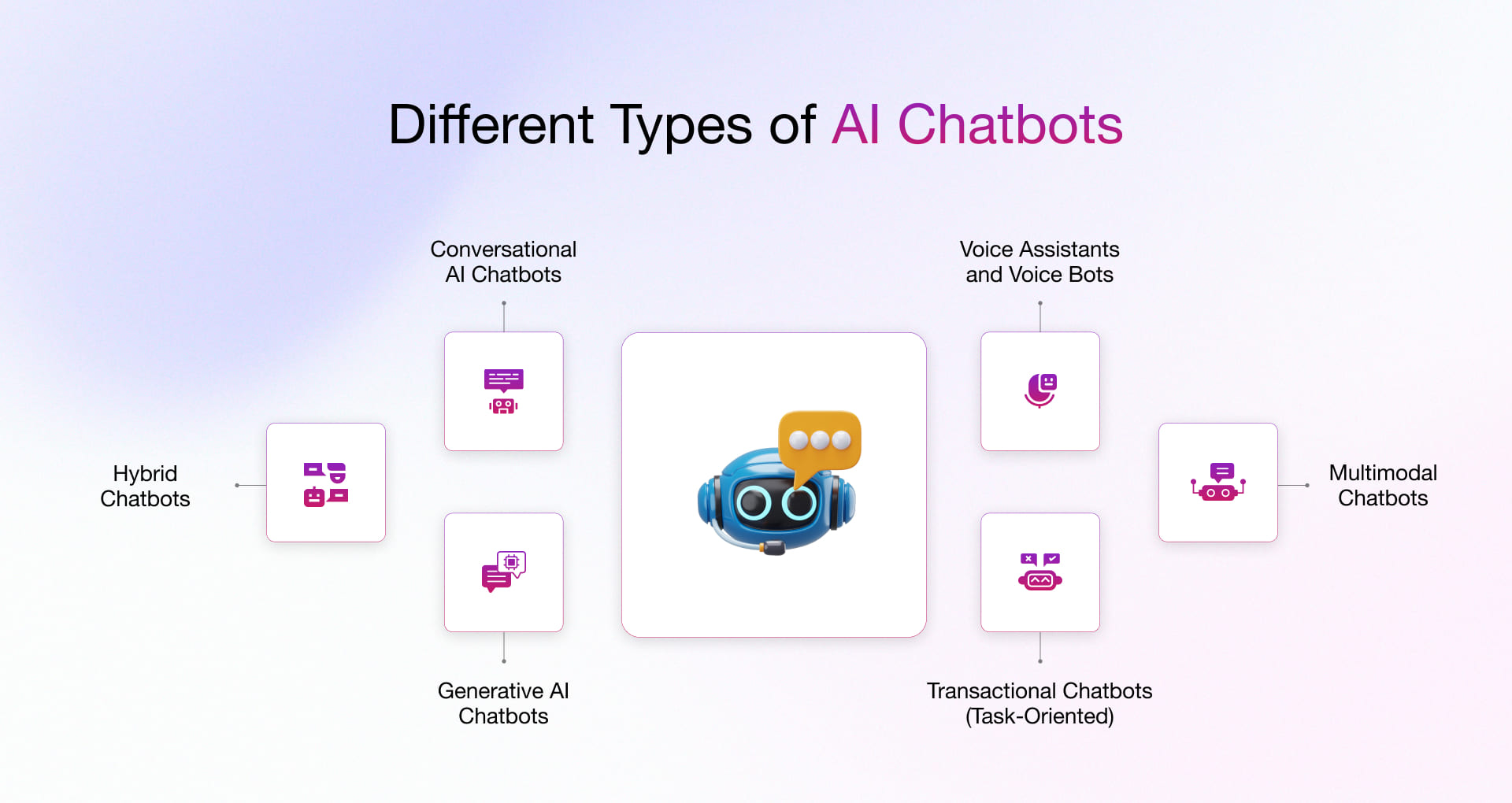
Types Of Ai Chatbots
There are several types of AI chatbots. Here are the main ones:
1. Rule-based Chatbots
These chatbots follow fixed rules. They can only answer set questions. If you ask something new, they do not know what to do.
2. Ai-powered Chatbots
These use artificial intelligence and can understand more complex questions. They learn and improve over time.
3. Hybrid Chatbots
Some chatbots mix rules and AI. They use rules for simple questions and AI for harder ones.
4. Voice Chatbots
These chatbots talk with users using voice, not just text. Examples include Siri and Alexa.
| Type | How it Works | Main Use |
|---|---|---|
| Rule-Based | Follows fixed rules | Simple FAQs |
| AI-Powered | Uses machine learning | Complex tasks |
| Hybrid | Mix of rules and AI | Both simple and complex |
| Voice | Uses speech recognition | Voice assistants |
How To Build An Ai Chatbot (simple Steps)
If you want to create your own AI chatbot, here are the basic steps:
Choose a Platform: There are many platforms like Dialogflow, Microsoft Bot Framework, and IBM Watson.
Define Goals: Decide what your chatbot should do. Is it for answering questions, booking appointments, or something else?
Create Conversation Flows: Plan the questions and answers. Make sure they are simple and clear.
Train the Chatbot: Use sample conversations to help the chatbot learn.
Test and Improve: Try using the chatbot. Fix mistakes and add new features as needed.
Launch: Add the chatbot to your website, app, or messaging platform.
Practical Tips
Start small. Begin with simple tasks and add more features later.
Use clear language. Avoid confusing words or long sentences.
Collect feedback from users to improve your chatbot.
Make sure your chatbot is safe and protects user data.
Common Uses Of Ai Chatbots In Business
AI chatbots are popular in many businesses. Here are some real uses:
Answering Customer Questions: Chatbots give quick answers about products, prices, or services.
Booking Appointments: Many clinics and salons use chatbots for booking.
Order Tracking: Stores use chatbots to help customers track orders.
Collecting Feedback: Chatbots ask users for reviews or ratings.
Lead Generation: Chatbots ask visitors questions to find new customers.
Employee Support: Companies use chatbots to help staff with HR or IT questions.
Data And Statistics
According to a 2023 report, over 70% of businesses now use chatbots for customer service. Research shows that chatbots can reduce customer wait time by up to 50%. Also, companies report saving 30% in costs compared to hiring more staff.
Ai Chatbots Vs Human Agents
Some people wonder if chatbots can replace humans. Let’s compare the two:
| Feature | AI Chatbot | Human Agent |
|---|---|---|
| Speed | Instant replies | Slower, can be busy |
| Emotion | Cannot understand feelings | Can feel and show empathy |
| Complex Problems | Struggles with tricky issues | Can solve complex cases |
| Cost | Low cost | High cost |
| Availability | 24/7 | Limited by shifts |
Chatbots are great for simple questions and fast help. But humans are needed for complex or emotional situations.
The Future Of Ai Chatbots
AI chatbots are growing fast. Experts say they will become smarter and more helpful. Soon, chatbots may:
Understand emotions and feelings better
Speak more languages
Solve harder problems
Work with other smart devices
Some researchers are working on “emotional intelligence” for chatbots. This means the chatbot could sense if you are sad or happy and respond in a kinder way.
Non-obvious Insights
Many people do not realize that AI chatbots can handle payments and security tasks, such as verifying your identity.
AI chatbots are now helping with mental health support, offering advice and checking on users’ feelings.
Risks And Safety Of Ai Chatbots
AI chatbots can be risky if not managed well. Here are some safety points:
Privacy: Chatbots often handle personal data. Make sure your chatbot is safe and follows privacy rules.
Fake Information: Some chatbots may give wrong answers if their database is not updated.
Bias: If a chatbot is trained with unfair data, it may give biased answers.
Security: Chatbots must be protected from hackers who might try to steal data.
How To Stay Safe
Only use chatbots from trusted companies.
Do not share private information unless you are sure it is safe.
Look for chatbots that use encryption and follow privacy laws.
Real-life Examples Of Ai Chatbots
Here are some famous AI chatbots:
1. Chatgpt
ChatGPT is an advanced chatbot made by OpenAI. It can write stories, answer questions, and even help with homework.
2. Siri
Siri is Apple’s voice chatbot. It helps users with phone tasks, answers questions, and gives reminders.
3. Alexa
Alexa is Amazon’s voice chatbot. It plays music, controls smart devices, and answers questions.
4. Google Assistant
Google Assistant helps users search the web, manage calendars, and control devices.
5. Woebot
Woebot is a chatbot for mental health. It talks with users and gives emotional support.
Unique Features
Some chatbots use images, videos, or links to make conversations more helpful. Others use speech recognition to talk with users.
How Ai Chatbots Change Everyday Life
AI chatbots are now part of daily life. Here’s how they help:
Quick Information: Get answers without searching the web.
Easy Shopping: Buy products or track orders with a chatbot.
Health Support: Chatbots give medical advice or help book appointments.
Learning: Students use chatbots to find answers or study.
More Insights
AI chatbots can help people with disabilities, such as those who cannot type easily.
Chatbots are now used in government services, helping people file taxes or ask questions.
Credit: www.rishabhsoft.com
Choosing The Right Ai Chatbot
If you want to use or build a chatbot, here are tips:
Check Features: Does the chatbot answer your questions, or do more tasks?
Ease of Use: Is it simple to use? Does it understand your language?
Safety: Is your data safe? Does it follow privacy rules?
Support: Can you get help if the chatbot fails?
Updates: Does it improve over time?
Comparison Table: Popular Chatbot Platforms
| Platform | Main Feature | Ease of Use | Price |
|---|---|---|---|
| Dialogflow | Google-powered NLP | Easy | Free & paid |
| IBM Watson | Advanced AI | Medium | Paid |
| Microsoft Bot Framework | Integration with Microsoft | Medium | Free & paid |
| Rasa | Open source | Hard | Free |
How To Interact With Ai Chatbots
Talking to a chatbot is easy. Here are tips:
Use clear, simple words.
Ask one question at a time.
If the chatbot does not understand, try rephrasing.
Avoid sharing private data unless the chatbot is secure.
Examples
“What time do you close?”
“Can you help me book an appointment?”
“How do I reset my password?”
Common Myths About Ai Chatbots
Many people believe wrong things about chatbots. Here are some common myths:
Myth: Chatbots are only for big companies.
Fact: Anyone can use or build a chatbot, even small businesses.
Myth: Chatbots will replace all human jobs.
Fact: Chatbots help with simple tasks. Humans are still needed for complex problems.
Myth: Chatbots know everything.
Fact: Chatbots only know what they are programmed or trained to know.
Myth: Chatbots are unsafe.
Fact: Most chatbots are safe if managed well.
Myth: Chatbots can feel emotions.
Fact: Chatbots do not feel. They can only respond based on data.
Frequently Asked Questions
What Is An Ai Chatbot In Simple Words?
An AI chatbot is a computer program that talks with people like a real person. It uses smart technology to understand questions and give helpful answers.
How Does An Ai Chatbot Learn?
Most AI chatbots use machine learning. This means they study past conversations, improve their answers, and learn new things over time.
Are Ai Chatbots Safe To Use?
Yes, most AI chatbots are safe. But always check if the chatbot comes from a trusted company and protects your private information.
Can Ai Chatbots Replace Humans?
No, AI chatbots are good for simple tasks. Humans are still needed for complex issues, emotional support, and creative work.
Where Can I Use Ai Chatbots?
You can use AI chatbots on websites, apps, social media, and smart devices. They help with shopping, banking, health, and more.
AI chatbots are changing the way people interact with technology. They help us save time, solve problems, and make life easier. As they become smarter, AI chatbots will do even more. Remember to use them wisely, choose safe options, and enjoy the benefits.
If you want to learn more, visit Wikipedia for deeper information. AI chatbots are not just the future — they are here now, ready to help.










This is a Software & Digital Product Reviews website. we focus on giving advice about online marketing and giving honest reviews of digital tools. Our goal is to give businesses and people the information they need to make smart choices in the digital world.
Stay informed with valuable tips delivered straight to your inbox.